

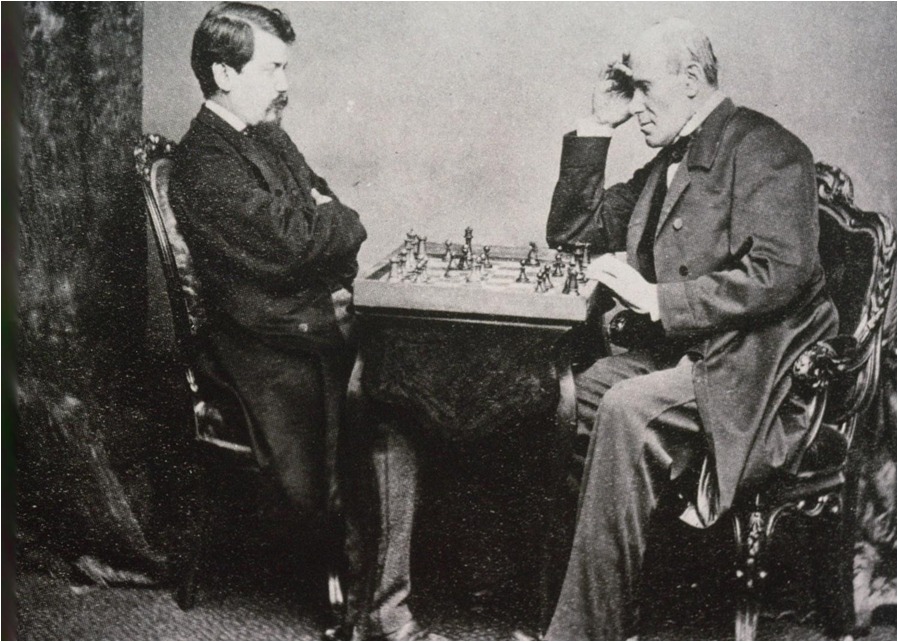
1.Ruy López de Segura (c. 1530-1580): Spanish priest whose 1561 book gave us the Spanish opening.
2.Gioachino Greco (c. 1600-1634): Italian “Calabrese” known for brilliant attacking games and early chess writing. He named the Itallian game.
3.Philidor (François-André Danican, 1726-1795): French master and musician who championed pawns as “the soul of chess.”
4. Domenico Lorenzo Ponziani (1719-1796): Italian theorist from the Modena school.
5.Alexandre Deschapelles (1780-1847): Dominant French player of the early 1800s who gave odds to rivals.
6.Louis-Charles Mahé de La Bourdonnais (1795-1840): Deschapelles’ successor, and the best player of his time.
7.Alexander McDonnell (1798-1835): Irish master famous for his matches against La Bourdonnais.
8.Howard Staunton (1810-1874): English player who won the 1843 match against Saint-Amant and was the leading figure of the 1840s.
9.Pierre Charles Fournier de Saint-Amant (1800-1872): French player who lost to Staunton in 1843 and later played Morphy’s circle in Paris.
10.Adolf Anderssen (1818-1879): German master who won the 1851 London tournament and the “Immortal Game” in 1851. He later lost to Morphy 8-3 in a match held in Paris 1858.
The immortal game
Adolf Anderssen – Lionel Kieseritzky 1851
1. e4 e5 2. f4 exf4 3. Bc4
The Bishop’s Gambit; this line allows 3…Qh4+, depriving White of the right to castle, and is less popular than 3.Nf3. This check, however, also exposes Black’s queen to attack with a gain of tempo on the eventual Ng1–f3.
3… Qh4+ 4. Kf1 b5?!
This is the Bryan Countergambit, deeply analysed by Kieseritzky, and which sometimes bears his name. It is not considered a sound move by most players today.
5. Bxb5 Nf6 6. Nf3
This is a common developing move, but in addition the knight attacks Black’s queen, forcing Black to move it instead of developing his other pieces.
6… Qh6 7. d3
With this move, White solidifies control of the critical center of the board. German grandmaster Robert Hübner recommends 7.Nc3 instead.
7… Nh5
This move threatens …Ng3+, and protects the pawn on f4, but also sidelines the knight to a poor position at the edge of the board, where knights are the least powerful, and does not develop a new piece.
8. Nh4 Qg5
Better was 8…g6, according to Kieseritzky.
9. Nf5 c6
This simultaneously unpins the queen pawn and attacks the bishop. Modern chess engines suggest 9…g6 would be better, to deal with a very troublesome knight.
10. g4? Nf6 11. Rg1!
This is an advantageous passive piece sacrifice. If Black accepts, his queen will be boxed in, giving White a lead in development.
11… cxb5?
Hübner believes this was Black’s critical mistake; this gains material but lacks in development, at a point where White’s strong development is able to quickly mount an offensive. Hübner recommends 11…h5 instead.
12. h4!
White’s knight at f5 protects the pawn, which attacks Black’s queen.
12… Qg6 13. h5 Qg5 14. Qf3
White now has two threats:
Bxf4, trapping Black’s queen (the queen having no safe place to go);
e5, attacking Black’s knight at f6 while simultaneously exposing an attack by White’s queen on the unprotected black rook on a8.
14… Ng8
This deals with the threats, but undevelops Black even further—now the only black piece not on its starting square is the queen, which is about to be put on the run, while White has control over a great deal of the board.
15. Bxf4 Qf6 16. Nc3 Bc5
An ordinary developing move by Black, which also attacks the rook at g1.
17. Nd5
White responds to the attack with a counterattack. This move threatens the black queen and also Nc7+, forking the king and rook. Richard Réti recommends 17.d4 followed by 18.Nd5, with advantage to White, although if 17.d4 Bf8 then 18.Be5 would be a stronger move.
17… Qxb2
Black gains a pawn, and threatens to gain the rook on a1 with check.
18. Bd6!
With this move White offers to sacrifice both of his rooks. Hübner comments that, from this position, there are actually many ways to win, and he believes there are at least three better moves than 18.Bd6: 18.d4, 18.Be3, or 18.Re1, which lead to strong positions or checkmate without needing to sacrifice so much material. The Chessmaster computer program annotation says “the main point [of 18. Bd6] is to divert the black queen from the a1–h8 diagonal. Now Black cannot play 18…Bxd6? 19.Nxd6+ Kd8 20.Nxf7+ Ke8 21.Nd6+ Kd8 22.Qf8#.” Garry Kasparov comments that the world of chess would have lost one of its “crown jewels” if the game had continued in such an unspectacular fashion. 18. Bd6! is surprising, because White is willing to give up so much material.
18… Bxg1?
Wilhelm Steinitz suggested in 1879 that a better move would be 18…Qxa1+;[8] likely moves to follow are 19.Ke2 Qb2 20.Kd2 Bxg1.[9] The continuation played is still winning for White, however, despite having many complications. The variation continues 21.e5! Ba6 22.Bb4! Qxe5 (22…Be3+ 23.Qxe3+/−; 22…Nh6 23.Nd6+ Kf8 24.g5+−) 23.Nd6+ Qxd6 24.Bxd6+/−.
19. e5!
This sacrifices yet another white rook. More importantly, this move blocks the queen from participating in the defense of the king, and threatens mate in two: 20.Nxg7+ Kd8 21.Bc7#.
19… Qxa1+ 20. Ke2
At this point, Black’s attack has run out of steam; Black has a queen and bishop on White’s back rank, but cannot effectively mount an immediate attack on White, while White can storm forward. According to Kieseritzky, he resigned at this point. Hübner notes that an article by Friedrich Amelung in the journal Baltische Schachblaetter, 1893, reported that Kiesertizky probably played 20…Na6, but Anderssen then announced the mating moves. The Oxford Companion to Chess also says that Black resigned at this point, citing an 1851 publication.[10] In any case, it is suspected that the last few moves were not actually played on the board in the original game.
20… Na6
The black knight covers c7 as White was threatening 21.Nxg7+ Kd8 22.Bc7#. Another attempt to defend is 20…Ba6, allowing the black king to flee via c8 and b7, although White has enough with the continuation 21.Nc7+ Kd8 and 22.Nxa6, where if now 22…Qxa2 (to defend f7 against Bc7+, Nd6+ and Qxf7#) White can play 23.Bc7+ Ke8 24.Nb4, winning; or, if 22…Bb6 (stopping Bc7+), 23.Qxa8 Qc3 24.Qxb8+ Qc8 25.Qxc8+ Kxc8 26.Bf8 h6 27.Nd6+ Kd8 28.Nxf7+ Ke8 29.Nxh8 Kxf8, with a winning endgame for White.
21. Nxg7+ Kd8 22. Qf6+!
This queen sacrifice forces Black to give up his defense of e7.
22… Nxf6 23. Be7# 1–0
With love for Mima


